Showing posts with label Gainsborough. Show all posts

Costume Desires (V): The Bad Lord Byron, Blanche Fury, Hungry Hill & The Gypsy and the Gentleman


Sydney Box courted trouble of quite another kind with “The Bad Lord Byron” (1948), which caused a stir both in England and America before a single foot of film had even been shot. The first problem was over the title itself, which caused a flood of angry letters to arrive on Sydney Box’s doorstep saying he was degrading one of the country’s finest poets ‑ before the script had even been finished. The press inflamed matters, managing to condemn the film and almost cause production to stop. Meanwhile, in the US there were censorship problems. Not because of the content of the screenplay presented to the censors, but because of the subject matter itself. They simply regarded the fact that a biography was being planned on such an outrageous character as reprehensible. Attacked from every side, Box decided he would prove them all wrong and make a film that was entertaining, truthful and tasteful.

Without doubt the lengths he went to provide historical accuracy cannot be faulted. For example, actual Byron furniture appears in some scenes (interiors set in his London club feature the poet's own dining table and chairs), and when such items could not be used they were scrupulously copied and built. The same was true for the costumes, which were reproduced down to the stitching. In fact, the struggle to finish in time for shooting was so great the studio needed to get help in: only the best were employed though, in this case from the Ministry of Labour’s embroiderers whose other assignment at the time was making Princess Elizabeth’s wedding dress. Even Byron’s shoes were minutely studied so that Dennis Price (who was playing the title role) could get the character’s famous limp exactly right. The problem was that it became such a habit for Price that he would continue to limp even after he had finished the take and walked off the set.


In terms of costume melodrama, the blend came nearer to being right with “The Bad Lord Byron”. Historical truth was there, but the framework of the story and the nature of the romantic element was close to the original Gainsborough method. The narrative begins at Byron’s deathbed in Greece, and then goes to a heavenly court where a judge presides over the case as to whether Byron was either ‘good’ or ‘bad’. The women in his life dominate the story and again come to signify the different social attitudes of society: Sonia Holm the quiet, sensible woman; Mai Zetterling the passionate Italian lover; and Joan Greenwood the pathetic figure torn between the two - an apt reflection for British women at the time who, with the war over, were finding their new found independence quashed as the returning males expected them to return to their old positions of inferiority. The director, David McDonald, aided by Stephen Dade’s glistening photography, stirs it all around with consummate style. The film also comes to represent the end of an era in film‑making ‑ the end of the Gainsborough costume melodrama. “The Bad Lord Byron”, though not a success in its day, has improved with age and now appears a swansong that favourably compares to the earlier hits.

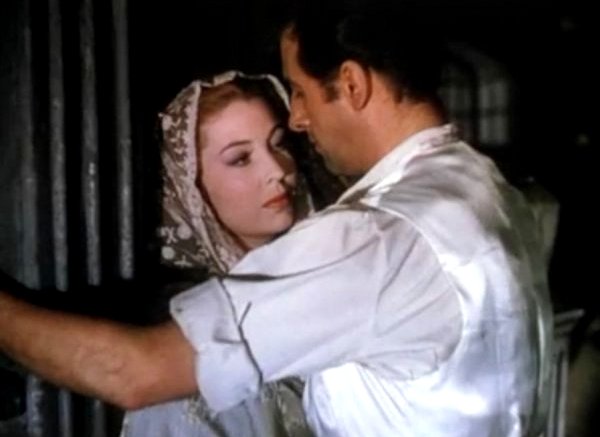

There were other companies willing to continue the genre (after all the films could still achieve reliable box office), yet somehow nobody else was able to reproduce the necessary kind of approach. “Blanche Fury” (1948) was a good try, which wisely recruited Stewart Granger as the male lead and brought in the old Gainsborough designer John Bryan to coordinate the startling sets. The production company was Cineguild and the film boasted some startling Technicolor photography along with a storyline ripe with burgeoning passions: young Blanche (Valerie Hobson) determines to make an independent, easy life for herself with distant relatives the Furys, but her cold façade crumbles when she falls in love with Philip Thorn (Granger), who has sworn to destroy the entire Fury family for robbing him of his inheritance. She soon finds herself trapped in plans of murder and intrigue. The producer was Anthony Havelock‑Allen, one of the creators of “In Which We Serve” (1942) and respected producer of “This Happy Breed” (1945) and “Brief Encounter” (1946). The director was Frenchman Marc Allegret, best known for his work on Alexander Korda’s “The Thief Of Baghdad” (1940). They brought a cool, classical touch to the film, but one which lacked the wild, sensual atmosphere that was one of Gainsborough’s secrets.

A similar fault marred “Hungry Hill” (1949), a Two Cities production. The notable writing credits list novelist Daphne du Maurier (it was one of her few screenplays) and Terrence Fisher (who later became famous for his spirited direction of the early Hammer horrors) and indeed the script was surprisingly literate. Unfortunately, the story moves in fits and starts as it covers the forty‑year feud between two ancient Irish families over the possession of the titular hill. The best scenes come when the large budget is fully utilized ‑ such as in the burning of the town or the expansive dance sequence ‑ and there are some good performances, especially the playful Margaret Lockwood, the mellow Dennis Price ­and the agonized Cecil Parker. The attention to detail is formidable: art director Vetchinsky spent months gathering together old maps, plans and photos so that his construction of the copper mine would be exact to the last plank of wood; Eleanor Abbey, the costume designer, studied for weeks at the British Museum in order that the clothes would be perfect; even musicians were hand‑picked and carefully trained to play instruments of the period.


But there was no real life left in these films any more. When director Joseph Losey tried to resuscitate the genre ten years later with “The Gypsy and the Gentleman” (1957), Rank got poor returns from the £250,000 they had invested, It was another splendid‑looking film, yet came across emotionally limp. (In a Losey retrospective held in Paris during the 1960s, the director requested that the film be shown silently, since he felt the images were tableaux that managed to tell their own story.) The film intended its appeal to revolve about the tempestuous, passionate Melina Mercouri. Instead the timing was wrong and she came across as merely frantic. As befitted the size of the budget there remained aspects to enjoy, however it mainly proved that in the gritty, downbeat 1950s the exuberant costume melodramas had no place.

British films had moved on and somehow lost the frenetic, wild and erotic feel that the Gainsborough lady represented. She and her productions, though, remain surprisingly immediate, style and themes transcending the time and remaining as vital and entertaining today.


Costume Desires (IV): The Magic Bow & Jassy


Kent’s erotically choreographed dances in “Caravan” exemplify the powerful use of music in these melodramas. A vital part of the Gainsborough formula is to link the romantic elements with a strong, memorable theme that weaves its way in and out of the narrative. In “The Wicked Lady”, it was Patricia Roc's love song; in “Madonna of the Seven Moons”, Phyllis Calvert’s mournful signature tune. With “The Magic Bow” (1946), though, the music actually became a central character. The film purported to tell the story of violinist Niccolo Paganini and his rise to fame as the greatest musician of his era, but its concentration was shifted more to his romantic life, and most especially the difficulties with his true love, Jeanne de Vermond. In itself a rather frivolous and slow‑moving movie, despite the careful work of the technicians (especially designers Andrew Mazzei and John Bryan in their re‑creation of Genoa), and in comparison to the other films it’s certainly disappointing. But there are some elements to enjoy.

Particularly strong is the casting of Stewart Granger, whose ably captures the moody, short‑tempered but charismatic Italian. Originally the part had been assigned to James Mason, who spent weeks practising the violin so as to get his miming perfect. In the end he fell out due to creative differences with director Bernard Knowles and subsequently sent his violin to Granger’s dressing room with condolences for the work he’d have to do with the instrument. Granger picked up the challenge with enthusiasm and his performances are convincing: face furrowed with determined intensity, his fingers fly across the strings with the confidence of someone who’s been playing all his life.


Opposite Granger is Phyllis Calvert - a teaming which marked their fourth and last time on screen together. As the emotional anchor, she commits to every scene and most especially in the final reconciliation sequence, where, shimmering in a rippling, sequinned white dress, she is the epitome of the romantic heroine. In reality the two stars didn’t get on well, but on celluloid none of this animosity is reflected: as screen lovers they radiate a charm and passion that is always endearing.

“The Magic Bow” proved to be the last production initiated by the Ostrer and Black management and was intended to be a prestige piece. As such it was even given its world premiere at the Cannes Film Festival. Its real claim to fame was the hiring of Yehudi Menuhin to play the violin solos. Producer R.J. Minney flew him from America, with the Stradivarius and player both expensively insured at Lloyds of London. It was worth it. The playing is not merely some elaborate publicity stunt, it adds another dimension and lends the film badly needed energy.


Sydney Box became the new boss of Gainsborough Studios in 1947, after the enormous commercial success of his famous James Mason and Anne Todd melodrama “The Seventh Veil” (1946). A stunning box office hit both in the UK and the United States (it played to full houses in one New York theatre for more than six months) and, though Gainsborough films were still raking in hefty ­profits, it was felt that his dynamism and experience could pivot towards modernizing the filmmaking style. Box and his wife, Muriel, shifted the emphasis towards modern melodramas, concentrating on contemporary, controversial issues and during his tenure, the company made its last two costume melodramas.

The first of these was the lavish “Jassy” (1947). In an interview, designer John Bryan revealed how he was told that ‘this was the big one ‑ we could do anything’, and from a technical perspective it is quite magnificent. Jack Asher’s luminous Technicolor photography creates a dream‑like atmosphere, whilst Elizabeth Haffenden, who did months of film tests to adapt from the black‑and‑white designs she had been used to on prior projects, provided sublime costumes, a wondrous combina­tion of soft pastel shades. And the sets (on which 90 percent of the film was shot) are quite outstanding in their scope and texture ‑ powerful reminders of a bygone era of film‑making.


Director Bernard Knowles was too concerned with these outward trimmings, though, and not wary enough of the uncertain narrative. It begins promisingly with drunkenness, suicide and a gypsy girl with powers to see the future. The girl is ‘Jassy’ Woodruffe (Margaret Lockwood) and it is her story that is mainly followed, through the murder of her father, her friendship with Dilys (Patricia Roc), the revenge on the man who killed her father and her eventual happiness in the arms of Barney (Dermot Walsh), a friend from childhood. Yet Lockwood's character changes so rapidly ‑ from revenge to forgiveness ‑ that the viewer is left with no story thread to hang on to; others characters are equally ill-defined and undeveloped. Reports of difficulties and delays in shooting account for some of this. but cannot excuse it all.

The best moments come when the film resorts to Gainsborough’s old style of visual dream: the lord (Basil Sydney) exploding into sadistic violence when he sees his wife being unfaithful; the villager beating his young daughter senseless in the kitchen; or Roc suddenly saved from the savage force of her father by being whisked away to an awaiting carriage in the arms of her young beau. The violence, in fact, gained a deal of notoriety at the time, critics branding Box a cheap sensationalist. One reviewer wrote: ‘Some film‑makers like to put their own personal signature on each film that they make… Alfred Hitchcock, for example, always makes an appearance on the screen. But Sydney, Box likes to distinguish himself by a gratuitous surplus of sadism’. It forced the producer to defend his artistic principles in an open letter to the press, in which he complained that he was simply trying to produce a piece of honest entertainment.


Costume Desires (III): The Wicked Lady & Caravan


Many regard “The Wicked Lady” (1945) as the epitome of the Gainsborough melodramas. Undoubtedly it is one of the most gloriously excessive, as Margaret Lockwood, bored aristocratic housewife by day, takes to the country roads by night as a fearless highwayman, robbing coaches and seducing any man she finds attractive. And Lockwood is perfect. Again she at first refused the part - but eventually decided it was, as she called it, ‘too meaty’ to refuse. Director Leslie Arliss said in a magazine article, ‘she represents an elemental character, full of the most human and natural passions and forced by her own desires into crimes the result of which she can never escape’. Despite the virtual unanimity of the critics in hating every single frame, the public flocked to the screens and made it the biggest money-maker of the year.


The novel on which the film was based, ‘The Life And Death Of The Wicked Lady Skelton’, was actually suggested to Arliss by Lady Eleanor Smith, who had written the book from which the earlier film “The Man in Grey” originated. The moment he started to read it, he knew he had the perfect material from which to make the next film. Immediately he headed to Maurice Ostrer, head of Gainsborough, and pleaded with him to buy the adaptation rights. Smiling, Ostrer informed the surprised Arliss that it was too late, he’d already purchased them just a fortnight before. With the intention that Arliss would direct.

Arliss received another more serious surprise upon the film’s completion: the Hayes Office (America’s film censor) refused to allow “The Wicked Lady” to be shown in the US. Apparently, the dresses worn by Margaret Lockwood and Patricia Roc were too low-cut and revealed far too much bosom. Since the US market was so large and of such commercial importance there was only one option - the offending scenes would have to be re-shot. It may seem ridiculous to the modern viewer, but that’s exactly what happened. Technical difficulties were enormous, with costumes and sets, long since scrapped, having to be painstakingly reconstructed exactly as they had been. Yet there was no other choice - more than twelve months after they had originally finished shooting, the cast and crew reassembled to make a tamer duplicate.


Today the film remains enjoyable nonsense (certainly superior to the 80s re-make) that is never less than entertaining. Yet for all its reputation, it ultimately remains a stagy piece. Leslie Arliss doesn’t have an instinctively cinematic eye and so, despite Jack Cox's sumptuous lighting and John Bryan’s evocative detailed sets, it becomes unfortunately stodgy.

In “Caravan (1946), however, the elements gel stunningly together. The director was former cameraman Arthur Crabtree and he brought to the film a supreme visual sheen. His two previous directorial attempts had been “Madonna Of The Seven Moons” and another Gainsborough picture, “They Were Sisters” (1944), and he builds on Madonna’s expressionism with verve and confidence. He was aided by a slightly higher budget than usual and John Bryan was able to use the full scope of the sound stages to construct some towering and near-abstract sets: they were the biggest ever built for a Gainsborough production and were mounted on huge rollers so that they could be pushed aside or folded away on the spot, enabling the camera to swoop and dive through seemingly impossible movements. The photography by Stephen Dade is another plus, continually on the prowl through richly and dramatically lit streets and rooms, milking every ounce of atmosphere; and editor Charles Knott cuts at such a pace that even though the film is remarkably long for its type (over two hours), it’s never dull.

But it is Crabtree's flamboyance that dominates, taking the viewer into the realm of another, almost surrealistic world. The pity was that in later years his undoubted talent was never fully utilized, and though he made some moderately successful films (and even the notorious horror piece “Horrors Of The Black Museum” (1959), which was widely criticized for its explicit violence), the list is not impressive. “Caravan” remains a testament to what could have been.


The story of Caravan is as melodramatic and incomprehensible as you could hope for. At the centre is the recurring conflict of flaming, uncontrollable passion and mannered, restrained civility, the opposing poles of the argument this time personified by two younger members of the Gainsborough repertory (both of them having served their apprenticeship in minor parts in previous films): the earthy, sexy jean Kent and the demure, principled Anne Crawford. And, of course, swaggering his way through the proceedings is the inimitable Stewart  Granger. He plays Richard Darell, aspiring writer, who finds himself split from his fiancée Oriana (Crawford) when he is asked to take some valuable jewellery to Spain by the wealthy Don Carlos, who in turn has promised to publish his first novel. But arch‑rival Francis (Dennis Price), determined to win Crawford's hand, dispatches his servant to make sure that Granger never returns, As a result Granger is attacked and robbed and left for dead. Gypsy dancer Rosa (Jean Kent) saves him, however, and nurses Granger back to health. She also introduces (and seduces) him to the uninhibited gypsy way of life.

It is eventually resolved in a welter of violence and emotion that ignites from the cooker‑pot atmosphere of sweltering sexuality. One of the most interesting aspects of' this carefully sustained atmosphere is the intelligent use of sound. Walter Hyden’s music skilfully interacts with the emotion and action, elevating the drama by careful combination with sound effects. Another example is with Elizabeth Haffenden's plush costume design: into Jean Kent's flowing gypsy gowns small bells were subtly sewn, so that when she performed her exotic dances, there was a continuous, delicate tinkling.


Costume Desires (II): Fanny By Gaslight & Madonna Of The Seven Moons


Following chronologically in the Gainsborough series, “Fanny by Gaslight” (1944) proved that “The Man in Grey” had been no flash in the pan. Again there were packed cinemas wherever the film was shown, and this time even the critics responded warmly. Director Anthony Asquith certainly toned down some the over-heated emotions and introduced a more realistic atmosphere, but it is still the melodramatic moments which stick in the mind, with James Mason once again the dark, brooding villain - one moment suave and charming, the next malicious and cruel. In an archetypal Gainsborough scene he is at a restaurant with his wife, played by Margaretta Scott: continually he scans surrounding tables, smiling at the women until, exasperated, Scott demands attention and a confirmation of his love - Mason simply turns to her and quietly states, as he kisses her hand, ‘I've never loved you.’

Mason is a vital part of the melodramas (a mantle mainly inherited by Dennis Price in later films), seemingly without any sort of motivation to inspire the unrelieved depravity and cruelty in which he indulges but nevertheless proving a powerful and charismatic figure. Mason himself was unable to explain how he played the parts. On “The Man In Grey” he said it was due to his inability to get on with director Arliss. ‘I wallowed in a stupidly black mood throughout and since my own imagination had contributed nothing to the character who appeared on the screen, I have to conclude that only my permanent aggravation gave the character colour and made it some sort of memorable thing’. Indeed, the fact that he seemed to be able to play these parts with such ease always disturbed Mason. who felt it was revealing a subdued aspect of his own personality; perhaps the reason for his popularity was that he also awakened the dark side of the viewer.


Phyllis Calvert, in the title role of Fanny, also gives a committed performance, initial innocence transforms to reality and a growing sense of responsibility. Based on the bestselling Michael Sadlier novel, the story centres round her tempestuous life, from an initially happy childhood home to the degradation of poverty and servitude, before her eventual salvation in the form of true love (and Stewart Granger, naturally).

The budget was once again relatively low (£90,000), but Asquith and cameraman Arthur Crabtree use the cramped interiors to great effect. This was mainly achieved by the clever placing of mirrors to give the appearance of depth and size that the sets would not otherwise have. The public loved every second ‑ the film grossed more than £300,000 on the first release and guaranteed the continuation of Gainsborough Studios for the next decade.

With the third film, Gainsborough began to perfect the formula, melding the visual elements of “Fanny By Gaslight” with the helterskelter histrionics of “The Man In Grey” to create a deliciously absurd whole. Once again the source material was a well‑known novel, though little but the premise remained intact. “Madonna Of The Seven Moons” (1944) is shot through with burning passion and longing which burn from every frame, and is unmitigated melodrama from start to finish. 

The central casting reteams Phyllis Calvert and Stewart Granger, the former giving another impressive performance as the schizophrenic Madalena / Rosanna, outwardly the quiet, discreet wife of an Italian wine merchant, yet bottling up hidden desires and rages which periodically take over. She literally becomes a different person, the gypsy lover to Granger's small-time Florentine robber, Nino. Thanks to Calvert’s skilful acting, they never become separate identities, for she imbues each with vestiges of the other, such that the dual-personality ploy is always convincing. For the actress it was a welcome break from the virginal innocents with which she was becoming identified. Indeed, for that reason producer R.J. Minney hadn’t primarily considered her for the part. But her ability to transform from wildness to conformity within the turn of a head eventually won them over.


One of the most interesting aspects of “Madonna Of The Seven Moons” is the picture of woman the film unveils. As Calvert lies dead at the end, her husband (John Stuart) and lover (Granger) place, respectively, a cross and a rose on her breast: this symbolic picture of her torn personality was an especially pertinent one to female audiences in war-torn Britain where the old ideals of morality and ‘the woman’s place’ were at last being questioned. In the film the conflict is finally resolved in the person of Angela (Patricia Roc), who sums up a new attitude, a liberal-minded independent young woman showing a form of emancipation and freedom that society in general was just beginning to deal with.

The publicity sold the film on its romance and especially ‘the searing love scenes’. In one of these, the Gainsborough style is shown to the full. Censorship at the time prevented showing a couple on a bed without each having at least one foot on the floor. To overcome this, the scene was shot in darkness, with Calvert and Granger seen in silhouette, their intense faces briefly illuminated only when Granger takes a drag on his cigarette. It is beautiful to watch, overtly suggestive and very powerful. In a review of the time, the Manchester Guardian said: ‘Arthur Crabtree has directed this superior thriller as if it were a work of art,’ and it is the imagination and flair of Crabtree, Italian designer Andrew Mazzei and cameraman Jack Cox that elevate the film beyond the boundaries of melodrama.


Costume Desires (I): Gainsborough & The Man In Grey


For almost a decade from the 1940s through to the 1950s a group of critically scorned British films proved to be the box-office hits of their day. High-flung over-wrought costume melodramas. Ingredients were basic: passion, romance, sadism, heroism and plenty of sex. Characters were forceful: dominant women, devoted lovers and violent, cold-hearted husbands. They arrived on screens at a time when Britain was entrenched in a desperate World War and longed for release.

The majority of the films were made by the productive and innovative Gainsborough Studios, located in Islington, North London. The company was established in the late 1920s by Michael Balcon and had been responsible for some of the most interesting films of' the 1930s including the lavish musical “Chu Chin Chow”, early Carol Reed efforts such as “Bank Holiday”, the Will Hay comedies, and Hitchcock's early British thrillers, “The Lady Vanishes” and “Young and Innocent”. However, it was upon the succession to administrative power of Edward Black and Maurice Ostrer that change was made.


Almost by accident, the rights to the novel 'The Man In Grey' was acquired and things were never to be the same. Perhaps success was the family atmosphere which the small studio was able to foster and sustain. On each film it’s essentially the same key technicians behind the camera, and the same regular stars and supporting cast in front. Though it was not all by design: wartime meant personnel was at a minimum and everyone was pitching in to help, a position further accentuated by relatively small budgets, and the necessity for productions to overlap.

Yet despite the constraints of money and manpower, one of the most impressive features of these films is a lush, dream-like veneer. Uniformly stunning to watch, they combine stark set design with stylish camerawork and opulent costumes to conjure up a distinctly sensual atmosphere, one that is deliberately unrealistic and overtly theatrical (indeed the costume designer Elizabeth Haffenden graduated from West End theatre). The look is never historically accurate, retaining modern influences so that the films seem to exist in some curious time warp. It lends them an ageless quality. None of which is to claim that the films need to be regarded as definitive cinematic masterpieces, simply that they should not be automatically dismissed, and that they deserve to be re-assessed as the entertainments their makers meant them to be.

Perhaps most of all, though, the Gainsborough melodramas are best remembered for the stars they created, a group of young talents who burst enthusiastically from the screen. The public was quick to respond: James Mason, the sexual, sadistic fiend; Stewart Granger, the dashing, well-mannered hero; Margaret Lockwood, the woman who knew what she wanted and how to get it; Phyllis Calvert, the resilient innocent tempted and preyed upon by evil; and Patricia Roc the bright epitome of the modem young woman.

Mason, Granger, Lockwood and Calvert were the four cornerstones of the films continued appeal. Indeed, their first film together, “The Man in Grey” (1943), immediately catapulted them to stardom. In terms of style, it perhaps lacks the panache of the later productions, but the involved, twisting narrative and emotional conflicts (characters are motivated through escalating degrees of lust, jealousy and pride) more than compensate. During the actual shooting, director Leslie Arliss said in an interview: ‘The background doesn't matter, it's the people you have in the foreground I want to find a human story about real people. I am not afraid of sentiment and am working to overcome shyness and to put unashamed feelings on the screen rather than to depend on speed or action.’ Little could he know, though, how phenomenally popular the results would be: audiences quickly helped it become the most financially successful film of the War.

The story involves the unhappy marriage of Clarissa (Phyllis Calvert.) and Lord Rohan (James Mason), both of whom are in love with other people: Calvert with an actor, Rokeby (Stewart Granger) and Mason with the cunning, vengeful Hesther (Margaret Lockwood). When Calvert decides that loyalty to the state of marriage supersedes her own feelings and refuses to elope with Granger, it all builds to a shattering climax, as Calvert is murdered by Lockwood who is in turn thrashed to death by Mason.

At the time cinemas were still packed with the heroics of British and American war movies, and only the determined, astute Maurice Ostrer believed he had a potentially hot property with Lady Eleanor Smith's novel. It was eventually made at a disused factory in Islington which had been transformed into Gainsborough's two sound stages out. The budget of £95,000 was one-third less than the average British production in 1943. It was released in August of that year and by the beginning of 1944 fan magazines were unanimous in bestowing on it Best Film awards.

Public reaction was particularly strong for Mason and Lockwood, although neither had originally intended to be in it: Margaret Lockwood said she was simply unprepared for such a nasty character, but finally realized it was too good a part; while James Mason had been originally cast in Granger's role, with Eric Portman set to portray Rohan, ‘the man in grey’.


The greatest uproar caused by the film came from the final confrontation scene, when Mason sadistically kills Lockwood with a whip. It created a whirlpool of outraged / excited letters from female fans convinced that Mason was like that in real life: ‘Are you really like that?’ ‘Do you treat your wife in the same way?' In the end the actor struck back and wrote a short article for the magazine Lilliput entitled ‘YES, I beat my wife’.

The whipping sequence is pure Gainsborough: beautiful people pictured in a glorious Regency setting, where emotions are liable to (and do) explode into sexual violence at any moment.


Films: July 27 - August 2

Jam (Sleep) (2023)  Pandora (2016)  Dang nan ren lian ai shi (Man In Love) (2021)  Nowhere (2023)  Godzilla x Kong The New Empire (2024) ...